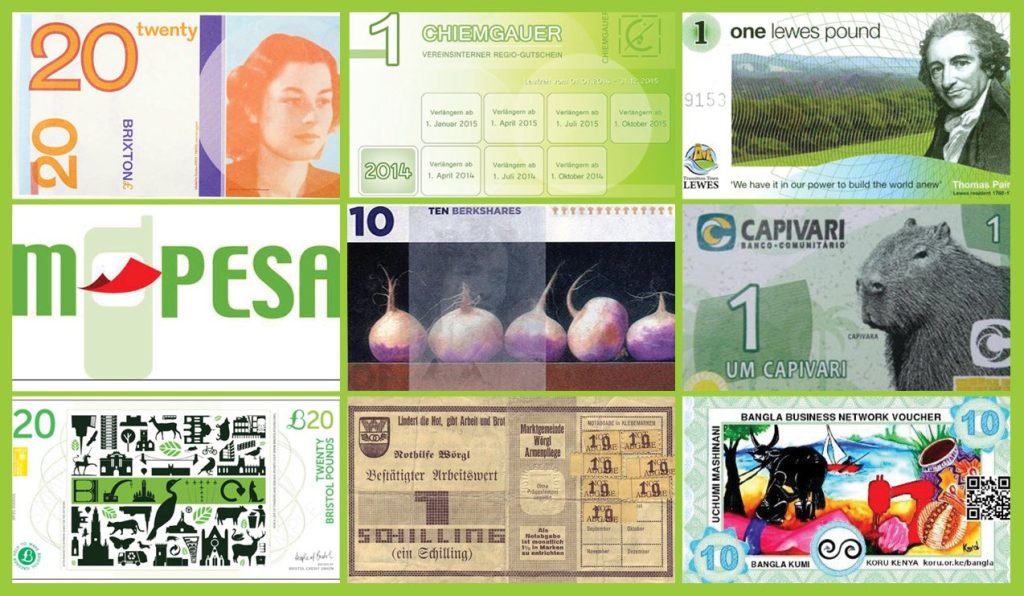
Ask anyone where money comes from and most will say “the Mint” or “the Treasury” or even more generally, “the government.” But most national governments create only about 3% of all the money in circulation. The other 97% is created by private commercial banks when they make loans.
This is what is known as “fiat money,” recognized by the government as legal tender for payment of taxes. But various forms of “people’s money” have existed for millennia. These “complementary currencies” have driven periods of abundance and well being.
Today, complementary currencies are often tied to “buy local” programs. We have developed a system for expanding the power of local currencies to benefit a wider user base.
For a quick overview of the concepts contained in the below three-part article, see the video on the home page and then read the article.
Money Old and New, Explained
All of our research efforts over the past decade inevitably brought us back to the issue of how to put more money in the hands of small businesses and communities, including capital and credit markets and the mechanisms to facilitate them.
Ultimately that led to examining money itself and exploring how it is injected into the economy. We came to realize that our previous efforts were defined by the existing money paradigm, and that to truly break free from the constraints of the current monetary system, money must be injected into the economy via alternate means.
With the right solution, local regions can, in essence, achieve economic sovereignty. In doing so, many, if not all, of the world’s current financial limitations could be eliminated.
The contents of those three sections are also available as a downloadable pdf document, “MONEY: A TIME FOR CHANGE: How complementary currencies can turn local economies around.”